Warehouse Floor Leveling Without the Downtime
Forklift-rated lift specs, off-hours scheduling, zone-by-zone work, return-to-traffic same day. Detroit-area industrial concrete leveling.
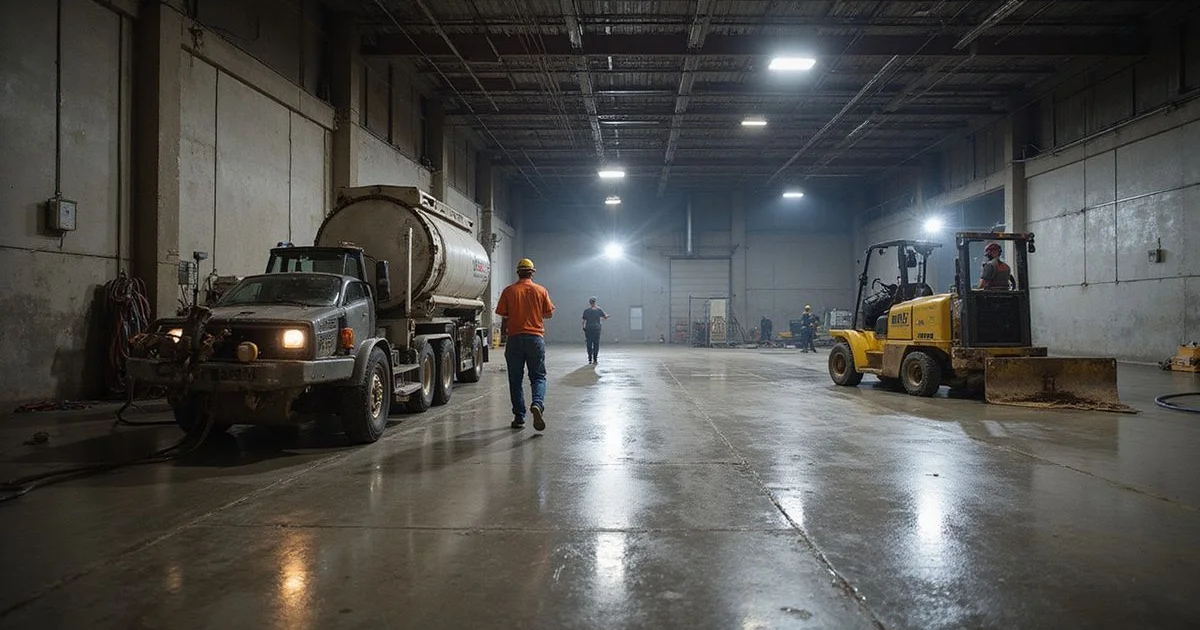
Our team knows that uneven concrete creates a massive liability for high-speed material handling, making warehouse floor leveling a top priority.
Ignored slab settlement inevitably leads to slower forklift speeds, damaged product, and safety risks. A 2026 Siemens industry report found that unplanned manufacturing downtime averages a staggering $260,000 per hour.
We specialize in fast-curing polyurethane leveling to prevent those catastrophic operational delays.
This guide explains the exact industrial materials involved. The following sections also cover scheduling options and specific processes for minimizing disruption.
Forklift-rated lift specs
Our limestone-foam hybrid and high-density polyurethane formulations easily achieve forklift-rated load capacity within hours of injection. High-density polyurethane foam supports massive loads up to 14,000 pounds per square foot. Formulations ranging from 5.0 to 8.0 PCF deliver compressive strength up to 200 PSI.
We document these final load ratings clearly in your post-job inspection report. Standard warehouse forklifts weigh around 9,000 pounds when fully loaded. The cured foam easily withstands the intense point-loading generated by these machines at the tire contact points.
Our technicians customize the injection material density based on your specific slab condition. Homeowners dealing with sunken driveways usually rely on lighter foams, but industrial concrete leveling requires premium strength. The table below compares the performance of residential and commercial materials side-by-side.
| Feature | Residential Foam (Driveways) | Industrial Foam (Warehouses) |
|---|---|---|
| Density Range | 2.5 to 3.0 PCF | 5.0 to 8.0 PCF |
| Compressive Strength | 40 to 60 PSI | 120 to 200+ PSI |
| Load Capacity | Standard vehicles | Up to 14,000 lbs/sq. ft. |
| Typical Use | Patios, pool decks | Heavy racking, forklifts |
Off-hours scheduling for warehouse floor leveling
We typically schedule warehouse floor leveling during your facility’s off-hours to eliminate costly operational interference. A single hour of halted logistics can cost a business well over $100,000 according to a 2026 ITIC study. Standard scheduling options include overnight shifts, weekend windows, or working between active production runs.
Our Metro Detroit clients overwhelmingly prefer overnight work for maximum efficiency. Crews start immediately after the final evening shift concludes. The floor is completely cured and ready for traffic before the morning crew arrives.
We offer four standard off-hours scheduling formats to fit your exact production rhythm.
- Overnight execution: Work occurs from 10 PM to 6 AM for zero daytime disruption.
- Weekend restoration: Saturday and Sunday shifts handle massive, facility-wide leveling projects.
- Single-shift windows: Technicians operate precisely between your active daily operations.
- Half-floor phasing: One specific zone is closed while the rest of the facility runs normally.
Zone-by-zone work
Our crews tackle larger floors in strategic zones using portable safety barriers to separate active repairs from your moving forklifts. The Occupational Safety and Health Administration (OSHA) requires highly visible barriers for any hazardous workspace inside a busy facility. Forklifts stay completely clear of the designated work area but operate normally in all adjacent aisles.
We utilize OSHA-compliant expandable barricades to clearly mark the 1/4-inch trip hazards being corrected. Polyurethane foam injection requires very little equipment footprint on the actual floor. This compact setup means the active work zone remains tightly contained during forklift floor leveling.
Managing Traffic Flow During Repairs
Our project managers map out these zones during the initial site walk to guarantee smooth traffic flow. Keeping aisles open is critical for maintaining your daily shipping quotas. The injection hoses can run hundreds of feet from the staging truck parked outside.
We keep the bulky equipment outdoors to maximize your indoor maneuverability. A smart layout ensures adjacent racking systems remain fully accessible all night. Facility managers consistently praise this low-impact approach compared to messy concrete replacement.
Return-to-traffic timeline
Our leveling process gets your floors back to full forklift traffic on the exact same day. High-density polyurethane foam reaches 90% of its full compressive strength within just 15 minutes of injection. Traditional mudjacking or concrete replacement can force a section closed for 24 to 48 hours.
We follow a highly efficient sequence to ensure zero lost production time.
- Site walk and scope: A manager evaluates the floor during normal business hours prior to the job.
- Overnight drilling and injection: Technicians drill small ports and inject the structural foam.
- Patching and grade verification: The crew seals the injection holes and confirms absolute levelness.
- Final material cure: Polyurethane cures in 15 minutes, while limestone-foam hybrids take a few hours.
- Forklifts back to work: Heavy traffic resumes immediately, often before the first morning shift begins.
The rapid 15-minute cure time is a massive advantage for busy distribution centers. Slabs return to service instantly without the frustrating wait times of epoxy or cement.
Our team easily handles sunken driveways quickly, but getting a massive warehouse back online requires this elite industrial speed.
Inspection and certification
Proper documentation from our inspections proves that your facility has actively eliminated dangerous 1/4-inch trip hazards. The official OSHA General Industry standard classifies any vertical change of this height as a violation.
We provide comprehensive post-job paperwork to verify that all elevation changes meet strict safety compliance standards.
- Pre-job elevation data: Exact measurements of the initial slab settlement.
- Port location lift heights: Detailed records of the lift achieved at every injection point.
- Final grade verification: Proof that the floor sits perfectly level and hazard-free.
- Certificates of insurance: Full coverage documentation for your corporate records.
- Written warranty: Long-term protection against the slab sinking again.
Facility managers must keep these records on file for compliance audits. Certified level floors drastically reduce the risk of workplace injuries and workers’ compensation claims.
Our staff ensures your maintenance file is completely up-to-date before the final invoice is sent.
Pair with joint sealing
Pairing your leveling project with polyurea joint sealing dramatically extends the lifespan of the entire floor. Warehouse control joints take a severe beating from hard forklift wheels and harsh chemical exposure.
We strongly recommend addressing these vulnerabilities before the concrete edges begin to crack and spall. Fast-curing polyurea joint filler sets completely in just one to two hours. Traditional epoxy fillers can take up to 24 hours to cure and only offer about 5% lateral flexibility.
Our preferred polyurea provides superior elongation, meaning it flexes dynamically as the concrete naturally expands and contracts.
Comprehensive Facility Maintenance
Beyond interior slabs, exterior logistics areas require the exact same attention to detail. You can explore more options by visiting the commercial concrete leveling service page.
Our expertise extends to your exterior asphalt and concrete surfaces as well. A sinking loading dock is just as dangerous as an uneven interior aisle. Read the parking lot leveling guide to see how the exterior approach works.
We frequently resolve sinking hazards in several critical exterior zones:
- Loading docks and ramps
- Semi-truck parking lanes
- Dumpster staging pads
- Employee pedestrian walkways
Prompt attention to these areas prevents expensive vehicle damage. The exterior environment faces harsh freeze-thaw cycles that accelerate slab settlement.
We are ready to map out a customized repair plan for your specific facility.
Simply Request a free estimate to get the conversation started about your warehouse floor leveling needs today.
Common Questions
Quick answers from our Metro Detroit crew.
Can you work overnight or weekends?
Will forklifts roll over the patches?
More from this topic
Commercial Leveling vs. Replacement: Cost & Downtime
Total cost of ownership: job cost + downtime + lost productivity. Insurance considerations. Multi-phase scheduling. Detroit commercial.
Cost of Commercial Concrete Leveling in Michigan
Pricing factors: square footage, slab thickness, access, after-hours premium. Typical project ranges and RFP guidance for Detroit B2B.
Parking Lot Concrete Leveling: What to Expect
Detroit parking lot leveling — pre-job assessment, traffic-control plan, lift sequence, joint sealing follow-up, post-job inspection and warranty.
Have a slab to lift? Let's take a look.
Free, no-obligation on-site estimate. If we can't fix it, you don't pay.